Friday, March 24, 2017

The Planning Begins


Image result for group teaching


Group 3 decided to start planning as early as we could. In the beginning of the semester, we would meet about once a week just to share ideas and start on the little things. Each group member brought their own laptops and would research on their own and then collaborate with the others. It eventually turned into the nitty gritty where we started writing the lessons and planning the slides and activities. We all collaborated on Google Docs and Google Slides so we could see what the others were doing as well.

For the lesson plans, we each completed certain parts of the lesson so it wasn't overwhelming for any of us. The same for the slideshow presentation. As a group, we focused on making the learning fun for the students considering this was an after school program. We wanted the students to become meteorologists and show interest in the topic of precipitation since it is so important to be familiar with. 

The days leading up to the lesson were pretty stressful, however we managed to pull it all together and kept our cool throughout the whole lesson even though it wasn't going as planned. 

Tuesday, March 21, 2017

PIGS

Image result for cooperative learning

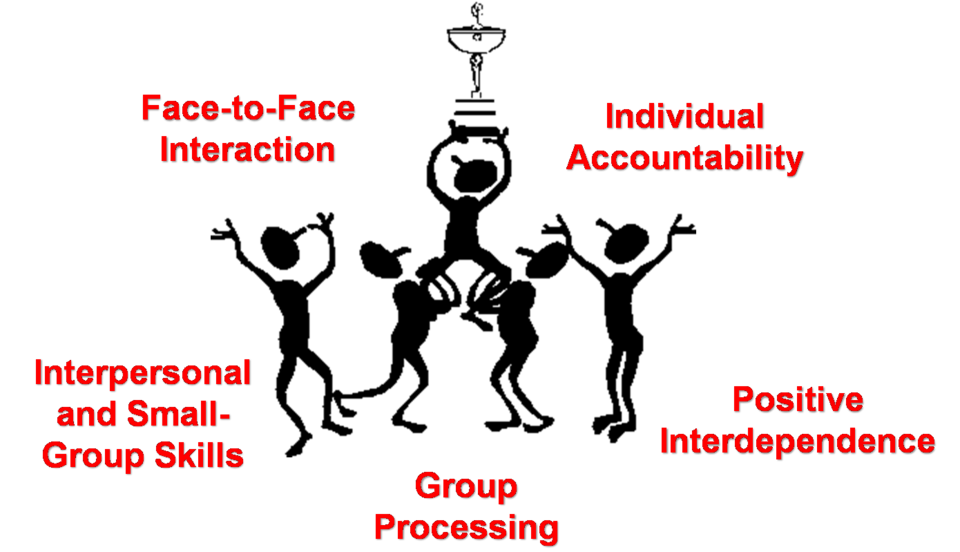
One component of a cooperative learning lesson, is that in the cooperative learning lesson, you must facilitate the 5 PIGS.


Positive Interdependence

Positive interdependence is when members of a group understand that they must work together in order to successfully complete the group's task. There are nine aspects of positive interdependence. The first aspect is that students groups should share a common gaol and that goal should be made clear by the teacher. The second aspect is that each student should have a specific role within their group. The third aspect is that students should share the resources they are using. The fourth aspect is that students should receive incentives for working well together. The fifth aspect is that students should be set up in a competitive environment. The six aspect is that students should work around a defined are. The seventh aspect is that students should design a group name. The eight aspect is that each student must have a task that needs to be completed in order to complete the final project. The ninth aspect is that you the students should use the roles to act out a situation or resolution.

Individual Accountability
Individual accountability is knowing that each individual is accountable for their work, and their learning. It is important for students to learn about individual accountability when they are participating in group work because you want them to understand that they are responsible for their contribution to the group work. Teaching individual accountability prevents students from "freeloading" during the lesson or waiting for their group mates to do all the work. When you teach students individual accountability, you teach them that they have to contribute to the group work and that their contribution should be meaningful. One way in which you can prove individual accountability is by assigning students roles within their groups. These roles can be a number of things such as leader or scribe or time keeper, etc. You can also promote individual accountability by keeping group sizes small, by observing each group and its group members as they work and by checking for understanding, and by having student complete self evaluation forms. Teachers should teach their students about individual accountability during the development of their lesson. They can teach students about individual accountability by talking to students about what makes a good group and their role in a group activity.

Group Processing
Group Processing is when group members analyze their own and the group's ability to work together. The purpose of group processing is that it focuses attention on group members' contributions in order to increase individual accountability, it allows the group to improve its work together continuously over time, it reduces actions that don't contribute positively to the group's learning and it makes the learning process simpler. Group processing belongs in the closure of a lesson. There are four keep components of group processing. The first component is feedback. Each student in the group must give and receive positive feedback on their contribution to the group. The second component is reflection. Students must analyze and reflect on the feedback they've been given. The third component is improvement goals. Individual students and groups must set goals fro improving their work. The fourth component is celebration. Groups must celebrate the hard work and contribution of each group member as well as the success of the group.

Social skills are the skills we need to interact adaptively in our cultural environment. Social skills include things such as communicating clearly, taking turns, listening actively, sharing ideas, etc. For a cooperative learning lesson, students need forming skills, functioning skills, formulating skills and fermenting skills. You can include forming skills in a cooperative learning lesson by having a noise monitor, a voice monitor, and a turn taking monitor. Functioning skills are the skills needed to manage the group's activities to complete a task and maintain effective working relationships among members. Functioning skills allow students to share ideas and opinions, ask for facts, and give directions to group members. Formulating skills help maximize students learning. They use higher reasoning strategies to strengthen mastery and retention of the learned topic. Fermenting skills are needed for the students to give appropriate feedback and have academic conservations with each other. You can teach social skills by emphasizing the importance of teamwork skill. Teaching students social skills helps improve their personal development and identity, it helps enhance their skills for future career success, it helps improve  their quality of life, it helps improve their physical and psychological health and it helps improve their ability to cope with stress.

Face to Face Interaction
Face to Face Interaction is when students promote each other's success by sharing resources through conversation and discussion. In face to face interactions, students help support, encourage, and praise each other's efforts to learn. The goals of face to face interaction are academic and social leaning/progress. In face to face interactions, a student orally explains how to solve a problem, a group member teaches classmates about a topic, and students help each other connect present and past learning.

Monday, March 13, 2017

Do you know?


Image result for earth


As future teachers, it is important for us to be familiar with as many topics as possible. In particular, it is important to have some sort of background in basic science. Because of this, we had to work in groups and decided on a topic that the whole group was not familiar with. We then had to find out more information and teach the class on the topic. 

My group was the least familiar with the different layers of earth's atmospheres. As a group, we split apart the different layers and each looked up information about the layers. We found videos and pictures to go along with the information. Once we found the information, we used ThingLink to put all the information together. 

ThingLink is an online tool that lets the content you're teaching come alive. It's engaging and you can display the information however you would like to. By all of the group members putting together the information, we all learned more about the layers of the atmosphere. 

Once the group members finished, we each taught our lessons to the class often reinforcing the same information. By doing this, we learned as a class new information to use in the future. We also learned new online tools to use in the classroom. This was a wonderful learning experience for the whole class. 

Friday, March 10, 2017

Inquiry vs. Traditional


Image result for inquiry vs traditional


In a traditional classroom, learning is focused on mastery of content, with less emphasis on the development of skills and the nurturing of inquiring attitudes. The current system of education is teacher centered, with the teacher focused on giving out information about "what is known." Students are the receivers of information, and the teacher is the dispenser. Much of the assessment of the learner is focused on the importance of "one right answer." Traditional education is more concerned with preparation for the next grade level and in-school success than with helping a student learn to learn throughout life. 

In general, the traditional approach is not as engaging as the inquiry approach is. The inquiry approach is more focused on using and learning content as a means to develop information-processing and problem-solving skills. The system is more student centered, with the teacher as a facilitator of learning. There is more emphasis on "how we come to know" and less on "what we know." Students are more involved in the construction of knowledge through active involvement. The more interested and engaged students are by a subject or project, the easier it will be for them to construct in-depth knowledge of it. Learning becomes almost effortless when something fascinates students and reflects their interests and goals. 


Assessment is focused on determining the progress of skills development in addition to content understanding. Inquiry learning is concerned with in-school success, but it is equally concerned with preparation for life-long learning. 

Friday, March 3, 2017

The Lessons Begin...


Image result for lessons


Today, the first group went up to teach both their direct and inquiry lessons in the hour and a half time frame. The first group taught all about solar systems. Being that this is an after school program, my colleagues had to accommodate to the grades fourth through sixth.They had to apply all the correct standards based on the grade and accommodate to the different learning levels.

I found out that four out of five have never taught a lesson before. Considering this, I thought the group did a phenomenal job teaching their first lesson. This lesson was definitely interactive and engaging for the students. Being that this was the  first lesson, the students were a little hard to control because this was the first time the rules had to be established.

While my colleagues were teaching. the rest of the class sat in the back of the room and observed everything that they were doing. We took notes on how they engaged the students and how they opened and closed the lesson, for example. I learned a lot from observing in the back of the classroom.

All in all, the first group did a phenomenal job! It's not easy going first!

Friday, February 24, 2017

What Do the Students Really Know?

Image result for question
The purpose of a pre-test is to test students knowledge on a particular topic in schools. Pre-tests are designed to pinpoint where the teacher should focus more on the lesson based on the results of the tests. If all the students get question 1 right, then the teacher knows not to review any of the concepts related to question 1. However, if half the class does not get question 6 right, then the teacher knows to review the concepts from that particular question. 

The process of creating a pre-test involves making a variety of questions that test what the students do and do not know. These questions may include: multiple choice, true/false, short answer and fill in the blank. The questions should be general and specific and geared towards what the students have learned previously. It also should be a fair variety of questions so the teacher can collect accurate data. 

For the science pre-test, each of the groups came up with 3-4 questions about their lesson topic. For example, my group is teaching precipitation, so we came up with 4 questions pertaining to precipitation. Then, we added the questions to Google Forms so one of my colleagues can put it together for the students. Once we received the results, my group was able to base what the students know and do not know to help us prepare our lesson. 

Friday, February 17, 2017

The Snow Finally Stopped!

Image result for cheering

This was our first day of class due to the amount of snow we've had. Our class was held in the science lab at Bishop Dunn Memorial School. When we had arrived, I was able to finally put a face to all the names in our class considering they have been held online. All the students then came in and they all seemed excited to be there which then made me even more excited. They sat next to their friends and became acquainted with the room. 

Before the class had started, we had to design a getting to know you activity to complete with the students. In my group, we decided to make a rain cloud filled with questions for the students to answer on the rain droplets. The students were excited to answer the questions and even share their answers. Many of them we found out liked Science and Math to be their favorite subject. We also got to learn all the students names and what they know about weather. 

After we answered the questions, we also completed a cloud-in-a-bottle activity. For this activity, you fill up a mason jar with water and then pour shaving cream on top of the water. Once the shaving cream is on top, you pour the blue dye through the shaving cream and it eventually looks like rain. The students were extremely fascinated to see and learn about what happens to the cloud. The students did not know very well why rain comes out of a cloud, so we explained it to them as the dye was moving through. Once the activities were completed, we gathered around and talked about what we learned that day, Everyone took turns and shared ideas along with likes and dislikes about the day. After the students shared, they left and the teacher candidates spoke about how the day went and what the schedule will be like for the remainder of the semester. All in all, it was a great first day!